Guillaume Dénervaud
Cadence
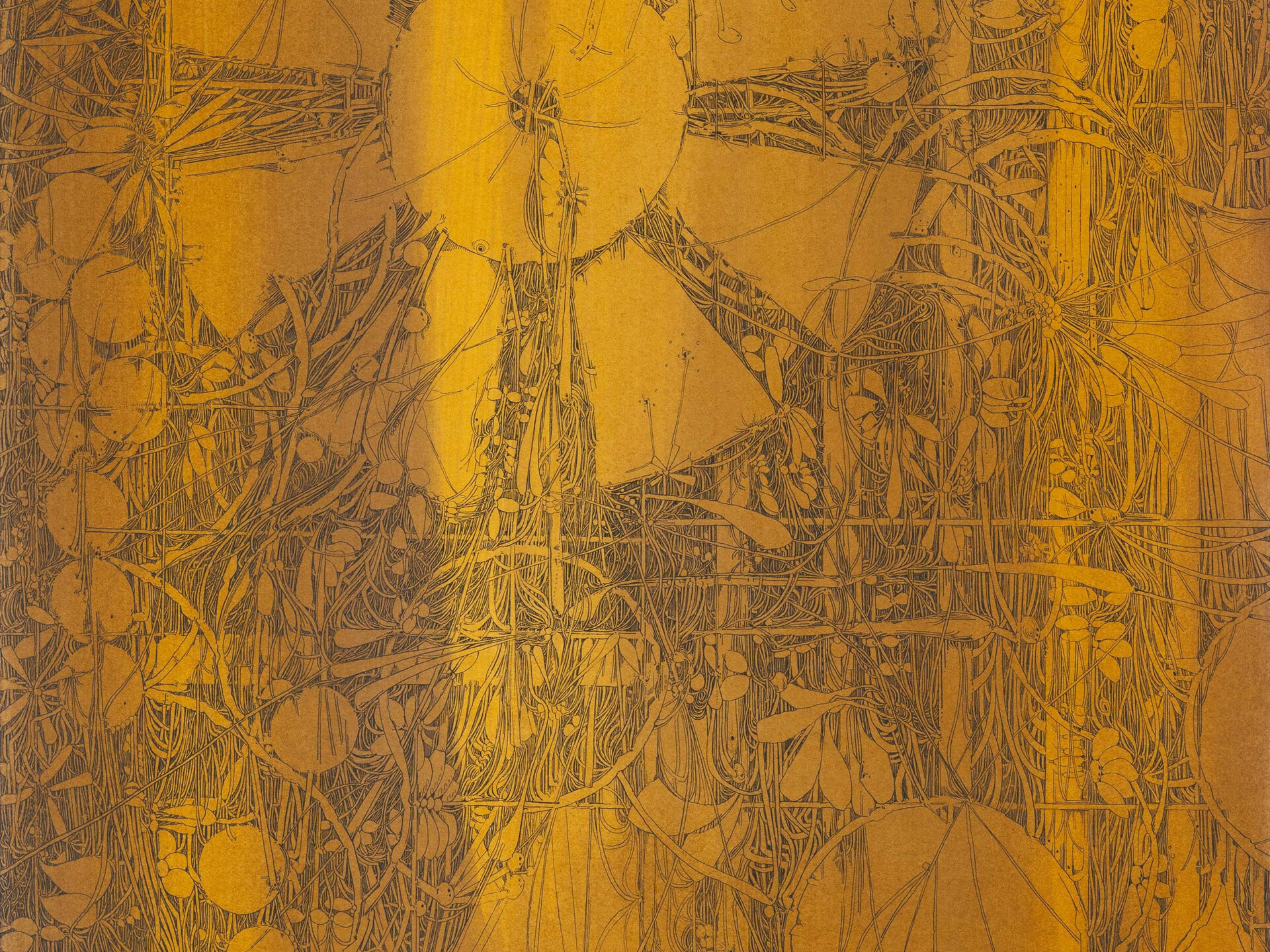
In the paintings and drawings of Guillaume Dénervaud (born 1987 in Fribourg, Switzerland; lives in Paris, France), organic and industrial forms merge, giving rise to moments of confrontation and harmony. This approach extends to the use of materials themselves, as the artist combines naturally occurring pigments with their synthetically manufactured counterparts. In his images, vegetative forms, cellular structures, technical apparatuses, wires, and circuits entwine to form complex pictorial surfaces. These interfaces typically develop out of lines according to a logic rooted in drawing, becoming more densely layered as the process unfolds. The edge of the image does not mark a definitive conclusion but rather points to a movement that could continue endlessly beyond the picture plane. Each individual image thus appears more as a cross-section or sequence within an ongoing continuum. Dénervaud’s works shift between detail and overall structure, between autonomous elements and systemic relationships. Individual drawn motifs merge into larger structures without entirely relinquishing their independence.
His paintings deliberately strive to create uncertainty about the scale of the forms depicted, how close or far we are from the objects, and what it is that we’re actually seeing. The ambivalence of whether we’re looking at a microscopic cell structure or a cosmic system light-years away raises the question of how these seemingly opposed and vastly distant worlds relate, as well as what energies circulate between them. Dénervaud devotes equal attention to the imperceptibly small and fragile as well as the incomprehensibly vast. The fact that both hold equal value in his work points to a holistic perspective in which the possibility of life, or in other words energy, can still be sensed as a fundamental, all-pervading principle, even where it exceeds the limits of our imagination.
In Cadence, Guillaume Dénervaud’s longstanding engagement with energy takes center stage. For a new series of black-and-white drawings, he varies the motif of a rotating propeller whose ceaseless activity seems to foreshadow its own collapse. These works touch on questions about productivity and energy generation, as well as the dynamics of perpetual extraction, self-consumption, and the depletion of planetary resources. In a new series of paintings, the artist conjures speculative landscapes that envision how life might emerge within a system that has become dysfunctional and unproductive—a possibility that is not only imaginable, but perhaps even necessary. They are filled with a diffuse, shimmering light that suggests a state of residual, or smoldering activity, leaving it open whether this activity is life-sustaining or threatening. A new sound work fills the spaces with a recording the artist made of his journey to the studio, which takes him from downtown Paris to an area outside the urban center, marking a moment of transition between city and countryside. This regular commute becomes a metaphor for the investment and expenditure of energy on larger social and economic scales. The historic loudspeakers playing the recordings are on temporary loan from the Swiss Museum and Center for Electronic Music Instruments (SMEM) in Fribourg.
Moreover, the exhibition extends Dénervaud’s strategies of “infiltrating” the white cube, in which he repeatedly challenges and transforms the viewing conditions of exhibition spaces. All the windows have been tinted with diluted ochre pigment, one of the oldest pigments used in Western painting, especially for rendering skin tones. The warm hue settles over the rooms and the works within like a kind of painterly glaze or filter. As such, visitors never encounter the works under “neutral” conditions, but rather as though a fine layer of dust had settled everywhere in the wake of the institution’s closure. This quiet act of sabotage reveals the conditions under which we view art and draws the exhibition space out of its supposed neutrality and autonomy from external influences.
The exhibition is accompanied by a collaboration with the Department of Art History and Archaeology at the University of Fribourg, which takes place parallel to the preparation and presentation of the exhibition. Titled Art and Ecology, the seminar led by Prof. Dr. Julia Gelshorn and Kathrin Bentele explores the aesthetic forms and artistic practices that have emerged since the 1960s in response to the changing relationships between humans, the environment, and technology. Together with the students, a reader accompanying the exhibition will be published, introducing the core concepts of discourses around the “ecologization of art.”
Further events will be announced throughout the duration of the exhibition.